



Analysis
Data from all agencies will be securely stored in a central database, which will feed the WADEPS data dashboard.
Practical analytical tools to identify trends, assess the effectiveness of police practices, determine whether training is effective, and encourage civic participation and dialogue.
WADEPS goal is to help all dashboard users—individuals, agency leaders, legislators, and researchers alike—expand their understanding of the data and derive meaningful insights.
- Learn how to identify trends and measure outcomes
- Assess agency performance across time
- Compare and contrast agencies across the state
- Understand the significance of unique numbers in the data

01
WADEPS Dashboard
Advanced data exploration tools for filtering, cross-tabulating, and visualizing data held by WADEPS.

02
Reportable Use of Force
WADEPS integrates agency and community data to provide context for reportable use-of-force.

03
FAQs
Got questions? The WADEPS Frequently Asked Questions (FAQ) has answers.
Get To Know WADEPS
Washington State Data Exchange for
Public Safety
A central, publicly available data dashboard surrounding the use of force by police and a common tool to objectively analyze and compare information and outcomes. Standardized and centralized data collection and visualization will provide the public, law enforcement, and policymakers with accessible, practical analytical tools to identify trends, assess the effectiveness of police practices, determine whether training is effective, and encourage civic participation and dialogue.
WADEPS Dashboard
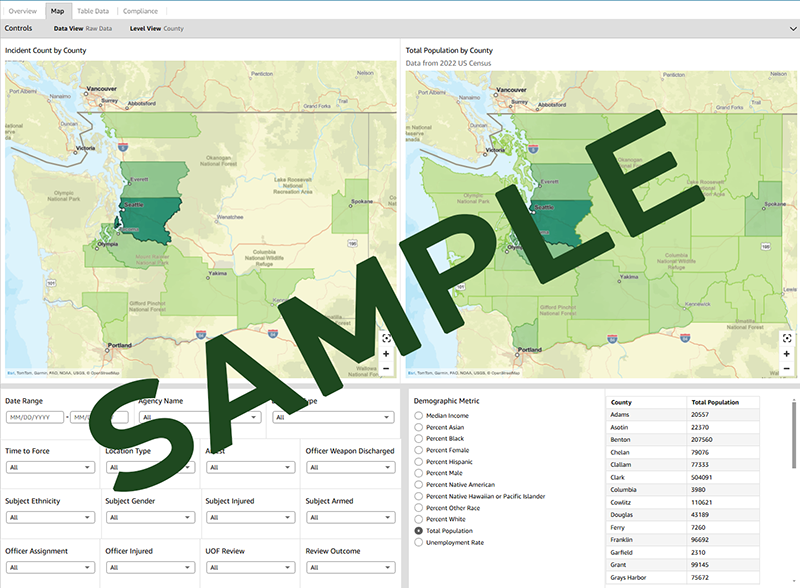
The dashboard allows anyone to examine police use of force with unprecedented detail, empowering communities, law enforcement agencies, and policymakers alike.
Its publicly available online data dashboard helps users better understand the frequency and nature of law enforcement interactions that result in the use of force.
WADEPS brings together information about the use of force by police that historically has been scattered across hundreds of state agencies with no standard for storage, sharing, or comparison and police-community interactions across the state.
WADEPS integrates contextual data about law enforcement agencies and the communities they serve to provide a more complete picture of the reportable use-of-force.
9
Dashboards

Available
Public data should be freely available. The WADEPS data dashboard provides a common tool for community members, law enforcement leaders, policymakers, and researchers to review and access all of the data.

One Location
WADEPS serves as the data custodian, securely storing the standardized law enforcement data in a central cloud-based data lake. Our data mirrors data held individually by agencies and other contextual resources and is updated daily.

Standardize
Data comes in all shapes and sizes. The legislature established a set of standard data points and definitions so data from all law enforcement agencies across the state can be compared accurately and equitably.

200+
Participating agencies

2194 +
Washington State active duty police officers

74%
Washington State provides Standard Setting portals.

30 Days
Data updated monthly.

Reportable Us of Force
As defined in Chapter 10.118 of the Revised Code of Washington [LINK], ten specific types of force used by police are reportable to WADEPS. This approach intentionally limits the scope of the state’s first standardized public safety data initiative to actions that are considered more likely to result in substantial harm, injury, or death.
Rate of Force
WADEPS integrates contextual data about law enforcement agencies and the communities they serve to provide a more complete picture of the reportable use-of-force.
1.1a
Reporting Agencies
WADEPS identified 301 law enforcement agencies with general or limited law enforcement authority operating in Washington in 2024.
WADEPS established six categories to track agency participation and compliance with the law.

- Required: An agency with general or limited law enforcement authority, operated by a governmental unit (municipal, county, state, etc.) within the state of Washington.
- Force Data Only: State agencies that do not use computer-aided dispatch (CAD) or other methods to track officer-community interactions or calls for service.
- Contracted: A municipal law enforcement agency whose officers are officially employed by a larger parent agency. The contracted agency may have its own local identity (such as police department uniform, patch, and/or vehicle graphics). View the current list (LINK TO 1.1a-orphan).
- Optional: Tribal law enforcement agencies operating in Washington are not subject to state law but may opt to participate in data sharing with WADEPS.
- Not Authorized to Use Force: State agencies with general or limited law enforcement authority whose officers are specifically not authorized to use force.
- Not Applicable: Agencies that are strictly administrative, inactive, or have been dissolved.
- >> Learn more about WADEPS reporting status [LINK to 5.7 FAQ section].
1.1b
National Comparison
Research by Washington State University criminologists looked at publicly available data dashboards across the country.
National Assessment of
Statewide Use of Force Dashboards
A inventory of statewide use of force reporting systems. This study examines 0 research-informed indicators to document what information is publicly available and where gaps remain.
Methods & References →States
Benchmarked
Standard-Setting Portals
Leading High AlignmentFoundational Portals
Initial ImplementationIndicator Presence Across States
Commonly Available ↔ Not Yet ProvidedAlignment Levels
- High Alignment (60%+) 0
- Advancing (30-59%) 0
- Foundational (<30%) 0
Audit Detail
What Are States Reporting & What’s Missing?
Explore how use-of-force reporting compares nationally. Follow the flows to see which key indicators are consistently shared across 13 state dashboards and where critical data gaps remain.
Reporting Standards
Standardized metrics used for national benchmarking
National Baseline Data Alignment
Methodology
Review the comparison methodology used to create the national comparison. [LINK to page 1.3a].